
Land Use Review Process Improvements Initiative

PWC Works projects reflect our commitment of striving for exceptional customer service, maximizing operational efficiencies, increasing modernization, providing excellent service delivery, and collaborating with the community for a coordinated response that achieves the best possible outcomes for our residents and the overall wellbeing of the county.
What is the Land Use Review Process Improvements Initiative?
Modernizing and Strengthening the Legislative Land Use Review Program
This initiative focuses on enhancing customer service, predictability and efficiency in the review of Rezonings (REZ), Special Use Permits (SUP), Proffer Amendments (PRA), Minor Modifications and concurrent Comprehensive Plan Amendments (CPA) and Public Facility Reviews through targeted staffing enhancements, digital modernization and data-driven process improvements.
Main Goals of the Land Use Review Process Improvements Initiative
The Land Use Review Process Improvements Initiative strengthens Prince William County’s legislative land use review program to better serve residents, applicants, and decision-makers while maintaining transparency, quality, and legal compliance.
Primary goals include:
- Improve customer service and transparency by establishing clearer expectations, predictable timelines, and consistent communication throughout the review process.
- Increase operational efficiency and capacity through strategic staffing enhancements and targeted use of on-call consultant support during periods of high workload.
- Advance modernization efforts by transitioning to online application submissions and coordinated digital plan review tools.
- Improve workflow predictability through standardized review cycles, scheduled post-submission meetings, and clearly defined applicant responsibilities.
- Support high-quality, defensible decision-making for the Planning Commission (PC) and Board of County Supervisors (BOCS).
- Use performance metrics to drive continuous improvement and data-informed resource allocation.
Process Improvements
The following process improvements are proposed to enhance efficiency, capacity, transparency and predictability in the review of legislative land use applications.
1.1 Addition of a Principal Planner
The Land Use Review Division received the addition of one Principal Planner to address increasing caseload demands.
- Current legislative caseloads significantly exceed those managed by peer jurisdictions and industry standards.
- The additional Principal Planner will support:
- Management of complex rezonings and legislative cases
- Mentorship and technical oversight of planning staff
- Quality control of staff reports, proffer analysis, and legislative coordination
- This position is critical to improving throughput and ensuring timely, consistent, and legally defensible recommendations to PC and BOCS.
1.2 On-Call Consultant Support
Funding was allocated to expand the use of on-call land use planning consultants through the County’s established A/E rotational task order contracts.
- Consultants assist with:
- Technical case review
- Drafting of comment letters
- Preparation of staff reports
- Consultants are currently assisting with active land use applications, with County staff providing oversight and coaching.
- This supplemental capacity:
- Helps maintain momentum during sustained high workloads
- Reduces delays related to staffing constraints
- Ensures cases progress within reasonable and predictable timeframes
2.1 Electronic Application Portal
To streamline intake and reduce paper-based submissions, the Planning Office is implementing an online application platform for legislative land use applications.
- A beta version for Special Use Permits launched on November 7.
- SUP applications have already been successfully submitted through the system.
- Expansion to Rezonings and Proffer Amendments is planned as system capabilities continue to mature.
2.2 Benefits of Online Submission
- Ensures complete and standardized digital submittals
- Enables digital signatures where appropriate
- Provides real-time application status tracking for applicants and staff
- Reduces administrative handling and physical storage needs
- Automatically archives submissions into the County’s EDMS for consistent recordkeeping
3.1 Bluebeam Integration
Beginning next fiscal year, the Planning Office will pursue Bluebeam integration to support coordinated digital review of Master Zoning Plans (MZP) and General Development Plans (GDP).
- Review agencies will annotate plans in a shared digital environment
- Comments will be consolidated into a unified markup layer
- Applicants will receive a single, coordinated markup set, reducing confusion and rework
- Positive move towards sustainability by reducing paper copies
4.1 Scheduled Post-Submission Meetings
To establish clearer expectations and improve coordination, a Post-Submission Meeting will be scheduled at the time the QC Letter of Acceptance is issued.
Process improvements include:
- QC Acceptance Letters will include a scheduled post-submission meeting date, typically two weeks after comments are due.
- A pre-meeting coordination check with review agencies will ensure comments are substantially complete prior to the meeting.
- The meeting will address:
- Key agency comments
- Preliminary issues
- Proffer or condition considerations
- Expected revision timelines
- Applicants will receive clear guidance and deadlines for their next submission.
5.1 Internal Review Timeframes
- Standard review cycle targets (e.g., 45 day or 30-day reviews) will be maintained and published for transparency.
- Automated notifications will be provided at key milestones.
5.2 Applicant Responsibilities
- Expected resubmission timelines will be established during the Post-Submission Meeting.
- This approach:
- Reduces idle cases
- Promotes mutual accountability
- Supports compliance with “Land Use Application Due Dates for Public Hearings.”
Success Criteria for the Land Use Review Process Improvements Initiative
Success Criteria for the Land Use Review Process Improvements Initiative will be measured through service delivery and performance outcomes, including:
- Increased use of pre-application meetings to reduce resubmissions
- Reduced average time from application acceptance to public hearing and completion
- Improved predictability and transparency for applicants and residents
- Fewer resubmissions and reduced rework during final submission cycles
- Improved ability to manage high legislative caseloads without increasing backlogs
- Reduced number of rezoning cases exceeding 12 months
- Faster post-approval closeouts, enabling quicker transition to site plan review
Performance Metrics and Outcomes
To evaluate effectiveness, the Planning Office tracks completed case metrics alongside workload and in-process indicators.
Summary of Key Metrics
|
Note: * Completion time without outliers; ** New Metrics
-
Fiscal Year 2026 (Starting July 1, 2025, through June 30, 2026)
Share Fiscal Year 2026 (Starting July 1, 2025, through June 30, 2026) on Facebook Share Fiscal Year 2026 (Starting July 1, 2025, through June 30, 2026) on X (formerly Twitter) Share Fiscal Year 2026 (Starting July 1, 2025, through June 30, 2026) on Linkedin Email Fiscal Year 2026 (Starting July 1, 2025, through June 30, 2026) linkRezoning Caseload Summary
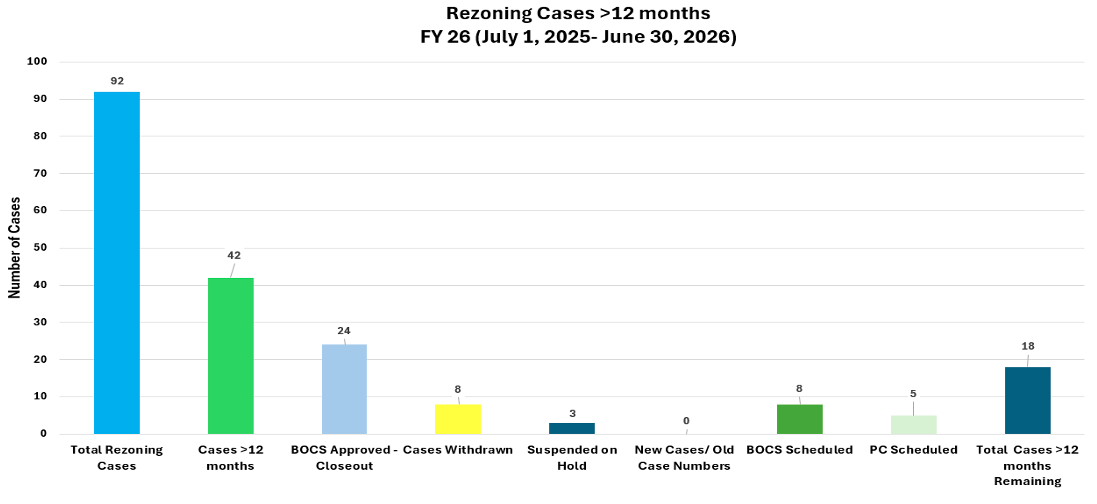
As of June 30, 2026, the Planning Office is actively managing 92 rezoning cases. Of these, 42 cases have exceeded 12 months in processing time, reflecting a significant portion of the overall caseload.
Progress continues to be made in reducing the older case inventory. 5 cases are in the final stages of resolution, including twenty-four cases approved by the Board of County Supervisors (BOCS) and pending closeout, and 8 cases anticipated to be dismissed. There are no cases currently suspended or on hold, indicating that all active cases are moving forward in the review process.
In terms of upcoming legislative actions, 14 cases are scheduled for public hearings, with 9 cases scheduled before the BOCS and 5 cases scheduled before the Planning Commission (PC).
After accounting for approvals, dismissals, and scheduled actions, the number of rezoning cases over 12 months is reduced to 18 cases remaining. The remaining workload includes 26 cases that are under 12 months, demonstrating that nearly half of the active rezoning caseload is still within the targeted processing timeframe.
Overall, this snapshot shows both the scale of the rezoning workload and the active progress being made to reduce the backlog of older cases, while continuing to advance new and ongoing applications through the legislative review process.
Total land use entitlement cases completed to date, including rezonings, proffer amendments, and special use permits.
- Average completion time (all cases): ~12.26 months
- Average completion time (Rezonings): ~13.01 months
- Average completion time (Special Use Permits): ~13.41months
- Percentage of Cases on the PC Expedited Agenda: 59.0%
- Percentage of Cases on the BOCS Consolidated Agenda: 77.91%
- Number of Pre-Application meetings: 64 cases
- Average Number of Days to Closeout: 16.93 days
Square feet of non-residential: 11.3 Million GFA
Number of residential units approved: 5,192 units
-
Fiscal Year 2025 – Completed Land Use Cases
Share Fiscal Year 2025 – Completed Land Use Cases on Facebook Share Fiscal Year 2025 – Completed Land Use Cases on X (formerly Twitter) Share Fiscal Year 2025 – Completed Land Use Cases on Linkedin Email Fiscal Year 2025 – Completed Land Use Cases link- 71 total land use entitlement cases completed, including rezonings, proffer amendments, and special use permits
- Average completion time (all cases): ~13.88 months
- Average completion time (Rezonings): ~13.45 months
- Average completion time (Special Use Permits): ~14.1 months
- Percentage of Cases on the PC Expedited Agenda: 58%
- Percentage of Cases on the BOCS Consolidated Agenda: 81.6%
- Number of Pre-Application meetings: 80 cases
Most cases were completed within reasonable timeframes given application complexity and scope of the Application.
Square feet of non-residential: 2.6 Million
Number of residential units approved: 2,742 units
Outlier Context:
Three cases within the FY 2025 dataset represent clear outliers due to prolonged applicant inactivity and extended periods on hold. These cases skew overall averages upward by several months and are not representative of typical processing timelines.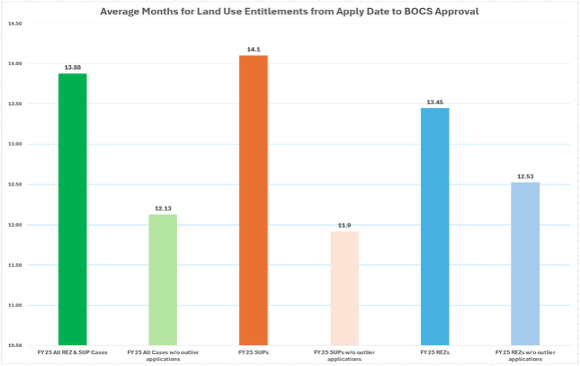

Sign up to stay updated!
-

Email [email protected] -

Email [email protected]